
Last updated: 2025-07-01
In 2025, my goal is to learn about the systems around us. (Read more here: Untitled) The idea is that understanding the way the world works will help me be more wise, connect deeply with others and build a life that feels calm, comfortable, and meaningful.
So, I’m reading my way through different kinds of systems this year. Systems of power, belief, care, economy, identity, and more. And because I’m me, I’m reading in sets of three so I can smash ideas together, feel how they fit together and think more creatively about how they express themselves. I’m also blending in fiction to help me stay grounded and grow my empathy for the individuals in these systems.
See all the books on Fable: https://fable.co/book-list/c4c6ae38-3648-481f-8f96-3fbe356567ae
Question ChatGPT on the sets: https://chatgpt.com/share/681cc459-5c8c-8001-88ff-5525e8487396
✅ Set 1: Emotions, Gender, and Wholeness
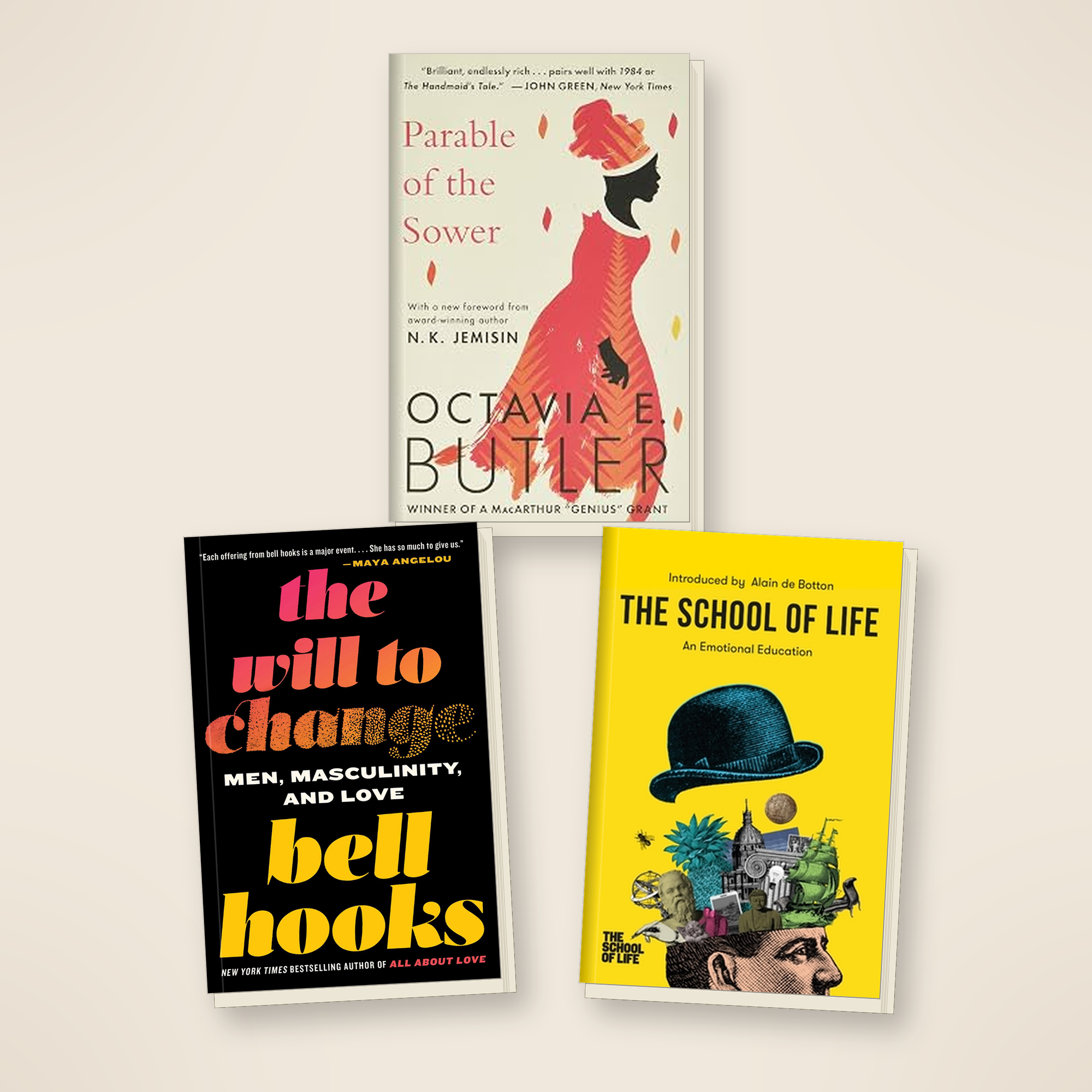
Together, this set asks: What happens when we grow up emotionally stunted—and call it normal?
- The Will to Change by bell hooks reveals how patriarchy wounds everyone, and invites men into healing without shame.
- The School of Life: An Emotional Education by Alain de Botton gently guides us toward emotional maturity in a world that never taught us how.
- Parable of the Sower by Octavia Butler imagines survival and transformation through radical empathy in a collapsing world.
As my first set, it was so eye-opening to how powerful systems-understanding is. The Will to Change helped me see how the patriarchy is reinforced through everyday behaviours of emotional manipulation — and helped me see how emotional stunted everyone in this society is, living with insufficient wholeness and love. At first I thought it was mostly for men, but it’s a must-read for anyone, regardless of gender. School of Life was the perfect complement for it because of the depth and breadth of which it covered emotional literacy. Not only providing practical tools, but also repeatedly reinforcing the theme of how hurt on the inside everyone is. Parable's fit wasn't as seamless, but it was a really good lead into my second set.
✅ Set 2: Capitalism, Ideology, and Meaning
Together, this set asks: What if the system is the problem — not us?
- Capitalist Realism by Mark Fisher helps me name the subtle, soul-crushing forces I couldn’t quite articulate.
- Mad in America by Robert Whitaker reframes mental health not as personal failure, but as resistance misunderstood.
- The Dispossessed by Ursula K. Le Guin offers an imaginative glimpse of what else might be possible.
I felt that this set was a bit poorly made, a fault of poor ChatGPT prompting. The books themselves were great, I especially loved The Dispossessed. Contrasting a capitalist world with a world built on anarchy was such a treat to read. Capitalist Realism was also good, although the reading difficulty was high, I was able to understand our system well. Mad in America was a good read but fell flat within the set. That being said, in hindsight it actually covered how broken capitalism is at mental health (an idea mentioned in Capitalist Realism). Maybe I would've had a better time in this set had I read Capitalist Realism first, instead of all at the same time.
🔜 Set 3: Community, Media, and Substitution
Together, this set asks: What happens when our communities conceal power instead of bringing connection?
- Amusing Ourselves to Death by Neil Postman reveals how communication’s medium reshapes thought, turning public discourse into spectacle and making us complicit in our own trivialization.
- The Gift by Lewis Hyde traces how meaning and connection emerge from non-transactional exchange, helping me see community not as a structure but as a sacred, unclosed circuit.
- Never Let Me Go by Kazuo Ishiguro exposes how tenderness, art, and memory can be hollowed out to maintain control, haunting with the quiet horror of belonging built on sacrifice.
This is the set I’m reading now.
👴🏾 Potential next sets:
🧠 Power, Propaganda, and Identity
Together, this set asks: Who gets to define reality? And who benefits from that definition?
- Americanah by Chimamanda Ngozi Adichie captures the lived experience of navigating race and immigration.
- Orientalism by Edward Said shows how the West exoticizes and controls others through “knowledge.”
- Manufacturing Consent by Noam Chomsky lifts the hood on media manipulation.
🎭 Social Structure and the Stories We Tell
Together, this set asks: How do the stories we live inside keep injustice alive—and how do we wake up to them?
- Such a Fun Age by Kiley Reid explores race and class through interpersonal dynamics.
- Caste by Isabel Wilkerson zooms out to show how those dynamics are embedded in hierarchy.
- Amusing Ourselves to Death by Neil Postman reminds us that the medium is the message — and we’re often sedated by entertainment.
🔧 Collapse and Resistance
Together, this set asks: When institutions fail, who builds the new world—and how?
- The Ministry for the Future by Kim Stanley Robinson shows how complex, messy resistance might unfold.
- This Changes Everything by Naomi Klein pushes back against greenwashed capitalism.
- Deschooling Society by Ivan Illich questions even the way we learn change.
🔚 Final Thoughts
This isn’t just about reading. It’s about thinking in systems. Feeling in systems. I want to be the kind of person who sees what’s really happening, who doesn’t internalize pain that belongs to a broken system, and who can build, connect, and love with clarity. I want to participate in this world with more intentionality.
If you're curious about any of these books, I’d love to talk.
Here’s to reading what matters.